

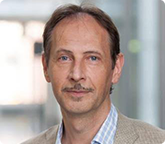
Fred Lisdat
Fred Lisdat has studied chemistry at Humboldt University and got his phd from the same university in 1992. His research interest turned from chemical sensors towards biosensors and thus, he made is post doc at Kyushu University in Japan. Since 1994 he joined the research group of Prof. Scheller at Potsdam University. He finalised the habilitation there in 2004 on the “Sensorial detection of signal molecules using redox conversions at protein molecules”. 2001 he was working as guest professor at Tokyo University in Japan. 2004 he got the Professorship of Biosystems Technology at the Technical University of Wildau. 2016 he has been working as guest professor at the Tokyo University of Agriculture and Technology.
He has been active in several national and international organisations, e.g. he was the president of the regional BioHyTec association (2000-2021), chair/chair elect of the International Society of Electrochemistry (2015-2021), head group of the “Arbeitskreis Chemo -und Biosensorik” of the GdCh (Society of German Chemists – 2018-24), head group of the section “sensors and sensor systems” of the Dechema association (from 2024) and general secretary (2013-21) or president (2022-27) of the Bioelectrochemical Society (BES). Furthermore, he is active in the coordination of the European Biosensor Symposiums conference series. 2024 he was awarded with the Bioelectrochemistry Prize of the International Society of Electrochemistry.
The research is focused on biosensing and biohybrid systems. This starts with sensorial developments for small molecules and radicals using protein electrodes and recycling schemes and has also turned to other enzyme-based electrodes. Particular focus is on direct protein electrochemistry and arranging proteins in artificial systems – often based on multilayer architectures. Another direction of research applies conducting polymers as interface for enzyme reactions on electrode surfaces.
In addition, bioaffinity based detection schemes have developed – here also other transduction methods such as SPR, QCM and impedance have been applied. Label-free detection of DNA and DNA binding molecules are one example. Photoelectrochemistry is another field of competence with the particular focus on combining enzymatic conversions with photoactive electrodes. These electrodes are based on quantum dots or other types od semiconductor nanostructures. Also photoactive protein complexes such as photosystem I and II have been combined with electrodes – here with the focus on energy conversion. This includes the development of new electrode architectures. Based on the work on enzyme electrodes and photoelectrochemistry also biofuel cells and photobiofuel cells have been developed which can demonstrate efficient light to current conversions but also analytical application potential as stand-alone devices.
Finally also application of methods of machine learning in the bioanalytical detection of catecholamines has been demonstrated. This is also relevant when enzymes are analytes by themselves since enzyme activity can be a valuable marker for several diseases. This has been exemplified with proteases and enzymes of the dopamine metabolism.




